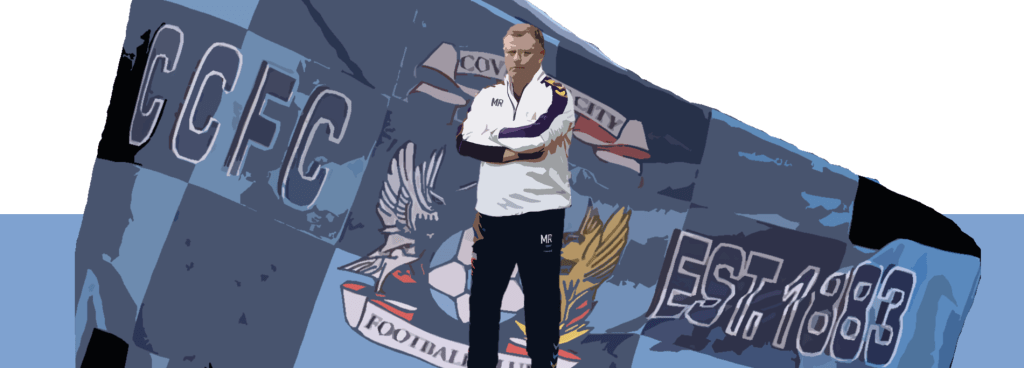
When Mark Robins returned to Coventry City back in 2017, my reaction at the time was that he was just ‘another manager’. The club, then tumbling down to League Two and possibly worse, had far bigger problems than any single manager could fix, while Mark Robins had been without a job for over a year – having been sacked by Scunthorpe United – and with a pretty underwhelming overall track record, aside from his previous spell at the club. How wrong that assessment turned out to be.
The reason Coventry City are in the Championship, nearly returned to the Premier League two years ago, comes close to selling out its stadium every week and have a squad that has had nearly £50 million spent on it is all down to Mark Robins. He inherited not only an absolute mess of a football club but one that had become accustomed to failure.
Within weeks of returning to the club, Robins won the Checkatrade Trophy, which was a huge step forward for the football club. Less so in purely footballing terms – just four players who featured in that first success played in the League Two Play-off Final the following year – but in rewriting the psyche of Coventry City. At what was the club’s lowest ebb, around 45,000 were roused to make the trip to Wembley and learn that it was possible for this football club to succeed. Destined failure became significant potential.
The summer that followed established the formula for success that would take Coventry City from the depths of League Two to the verge of the Premier League. SISU, who were happy to cede control of all footballing decisions to someone who actually wanted them, let Mark Robins make not only key signings but key appointments off-the-pitch.
Mark Robins made Coventry City his football club and was smart enough to let people who were experts in their own field have the licence to excel in their roles. From Tommy Widdrington and then Chris Badlan on the recruitment side to the key figure of Adi Viveash as coach, Robins acted as a good CEO of the football club, rather than an old school manager, delegating effectively and leaning on the expertise of others.
The problem-solving ability of Mark Robins and his staff was the key feature of his reign at Coventry City. There is no specific style of play that unites each of the manager’s successful teams at the club, instead, it has been that ability to respond to challenges, whether tactical, personnel-wise, or off-the-pitch, and improve that defined the Robins era.
From the League Two side that had that strong core of Liam Kelly and Michael Doyle, allowing Jodi Jones, Tom Bayliss and Marc McNulty to excel in front of them, the League One side that were masters of controlled possession with Liam Walsh running the show, to the Play-Off Final reaching side that were defensively rock-solid, knowing they had the two aces of Gustavo Hamer and Viktor Gyokeres to win games at the other end. Players came and went, both tactics and styles of play changed, the only through-line was Mark Robins and his key appointees.
The statement from the club on Mark Robins’ sacking underlines what exactly has changed between those eras of success and now, it’s the transition of decision-making from Robins to Doug King. In retrospect, the writing was on the wall when Adi Viveash left this summer, replaced with a number of coaching staff, of whom will now lead not just this transition period but the future of Coventry City.
The change of ownership has proved both a blessing and a curse for Coventry City. The level of spending on this squad is far in excess of what would have been sanctioned under SISU, along with the clear improvements that have been made to the training ground and the matchday experience at the CBS Arena. It has come at the cost, however, of upsetting what had been a successful formula where Mark Robins and his appointed associates made all of the key decisions.
The decision to sack Mark Robins is the culmination of a process of taking control away from the manager that has taken place during Doug King’s early years in ownership of the football club. From being a club that had to postpone games due to the parlous state of the pitch and had a squad glued together with free transfers and loanees, to one that nearly sells out every home game and has multi-million pound players in every position, the progress under King has been rapidly and, on paper, positive.
While the overall form since the start of April hasn’t been great, it was not bad enough to put Mark Robins in an untenable position. Recent wins over Luton Town and Middlesbrough seemed to have arrested the slide and while the performance and result against Derby County last time out was poor, Robins was trusted by most to ride out this difficult spell and find a way forward. This was a decision that Doug King, or whoever else was involved, didn’t have to make.
The overriding feeling is that is incredibly sad, almost a betrayal, that this Mark Robins era, one that has been just as transformative for the club as Jimmy Hill’s was back in the 60s, has been ended so abruptly. For Doug King, the head coach who is next appointed will carry the pressure of having to justify such a decision.
For all the positives that Doug King has brought to the club, there is little indication yet as to how competent a decision-maker he really is when it comes to football. Spending more money and investing in facilities can increase chances of success but it is no guarantee.
From wondering seven-and-a-half years ago as to whether Mark Robins was just another football manager, the danger now is that Coventry City becomes just another football club.



 Sideways Sammy
Leave a reply to Smaller Days Cancel reply