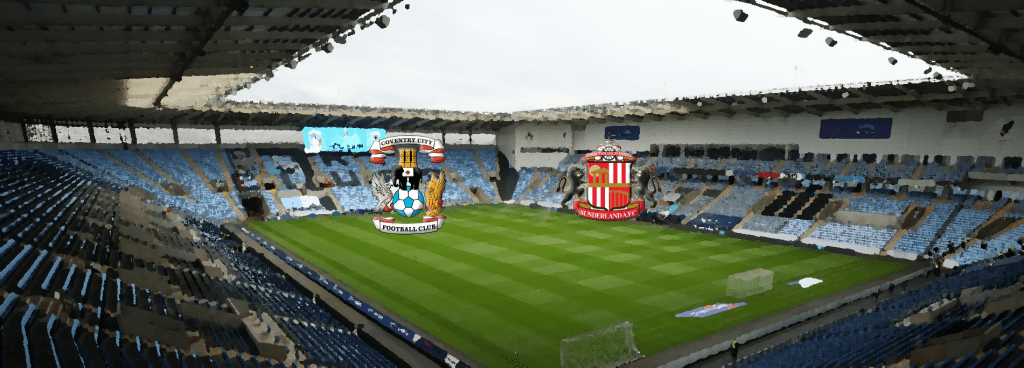
Coventry City and Sunderland had to settle for a goalless draw at the CBS Arena in a game where there was plenty of technique on show but little guile or threat in the final third.
The first-half very little goal-mouth action, with the best chance being one for Ellis Simms for Coventry City just before half-time, which came on both on his wrong side and at an acute angle, making for a routine save for Anthony Patterson in the Sunderland goal.
The Black Cats stepped things up in the second-half, with Jack Clarke looking a danger down their left flank, but the Sky Blues defended well enough to prevent that leading to any particularly dangerous shots on goal. The home side could have won it late on, when a counter-attack saw Yasin Ayari slide through Haji Wright, only for it to draw a good save from Anthony Patterson to ensure the final score would be 0-0.
Tidy But Not Dangerous
Coventry City are looking to evolve their style this season towards playing out from the back more deliberately and creating chances via longer spells of possession. They rarely looked under pressure when moving the ball between their three centre-backs and often were able to play into midfield, the problem was what happened next in what was a pretty stodgy creative performance.
For all the energy that Ben Sheaf and Josh Eccles provide the team in central midfield, they struggled here against a Sunderland side that held a good shape off the ball, cutting off easy passing lines into the attack. Both midfielders tend to prefer playing short give-and-go passes when looking to speed up the attack, which wasn’t the order of the day against an opponent defending narrowly through the centre of the pitch.
The challenge here was to play the bigger passes to switch the play quickly, or very accurate balls over the top to get the strikers into the game. Ben Sheaf was particularly disappointing in that regard as he has the ability to play those kind of passes but seems to lack the vision to do so. This is why there remains talk of having to source a Gustavo Hamer replacement in the transfer market, rather than in-house.
Coventry City’s biggest creative threat in this game was Kasey Palmer, who was willing to receive the ball in tight areas and begin driving instantly at the opposition. His end product continues to be hit and miss – and probably more on the miss end of that spectrum – but he stood out here as a risk taker in an otherwise safe effort from the Sky Blues. Additionally, Yasin Ayari off the bench looked confident in his touch and played with his head up.
It’s important to remember that it is still early days for what is effectively a new team trying to play a new style of play. This Sky Blues side deserves credit for how well they have been able to play out of their own half, that next step is going to require a combination of the natural understanding that comes with time on the pitch and players being a little more willing to take risks than they were in this game.
Runners Needed To Create Penetration
Exacerbating the issue of a lack of risk-taking in possession was the off-the-ball movement, which made Coventry City particularly stodgy in this game. It’s easier said than done, particularly when the opposition is so dangerous on the break, but the Sky Blues rarely stretched their opponents when they had long spells of possession which perhaps is down to the tactical set-up.
Coventry City’s 3-4-1-2 system requires the wing-backs and wide centre-backs to make step forward from their starting positions in order to prevent the midfield and attack from being marked out of the game. One of the key issues there is that Mark Robins likes the wing-backs to drop into the back three when out of possession, meaning that their starting position is deep as they look to join the attack. Furthermore, they are often left alone when on the ball out wide, meaning they have to beat multiple opposing players before they are in dangerous areas.
A key reason in this game why the wing-backs weren’t bursting forward with abandon was Sunderland’s threat on the counter-attack. The Black Cats’ left-winger, Jack Clarke, in particular, required attention to prevent causing danger. Furthermore, there were a couple of occasions where the back three were left on their own to deal with opposing breaks, which put Kyle McFadzean in some awkward situations against quick opposing attackers. This was also probably why Tatsuhiro Sakamoto was not used later on in this game due to the concern of him being left one-against-one at right wing-back against Jack Clarke.
Instead, the Sky Blues’ best chances here were largely on the break, when the front three had the space to receive the ball and drive directly at the opposing goal. During slower phases of play, the attackers were surrounded by opposing defenders and there wasn’t the guile from either themselves or the team to get them in on goal.
Currently, Coventry City are utilising a formation that worked for them last year in a counter-attacking style while deploying a different style of play. Part of the issue is that so many new players have been thrown into the mix and are still trying to figure each other out, but there may be a question soon as to whether this shape is the best way to execute this team’s new approach.
Long Throws Could Ease Awkward Phase
In what was otherwise a pretty stolid affair between two teams lacking the ability to play the decisive ball in the final third, the revelation that Milan van Ewijk is capable of long throws was notable. While long throw-ins may seem anathema to the kind of short passing game that Coventry City want to execute, effectively adding another set-piece threat to the team’s arsenal should not be dismissed.
Just how dangerous Milan van Ewijk’s long throws can be remains to be seen. The Dutch right-back’s hurls were slow, floaty and didn’t clear much distance, which should have been easy for Sunderland’s defence to head away at the first opportunity. In fact, one of the opposition’s best counter-attacks came from a Coventry City long throw, taking advantage of winning that first contact and being able to run at a defence whose centre-backs were at the other end of the pitch.
What threatened to make the long throws dangerous for Coventry City was the team’s organisation and physicality in the opposing penalty area. Almost all of the Sky Blues biggest players were camped in the six-yard box, grappling with Sunderland defenders to make it difficult for the opposition to clear the ball with confidence. Even if the throws weren’t dangerous in and of themselves, it added a source of uncertainty to the opposition when, typically, clearing the ball into touch can be a source of relief.
Whether this was a tactic specific to the opposition of the day, a slight, technical Sunderland team, or is something Mark Robins will look to continue moving forward will become apparent in the ensuing weeks. The last time Coventry City had a long throw-in taker, Sam McCallum, it became a useful part of the team’s bid to stay in the Championship ack in 2021, showing that the manager isn’t ideologically opposed to the tactic. At a time where this team is struggling to create in open play, long throws could be useful in easing that transition.


 Sideways Sammy
Leave a reply to clarriebourton Cancel reply