
The signing of Liam Kitching on summer transfer deadline day brought to an an end a summer in which Coventry City made what was probably four of the ten most expensive signings in its history, after a period of around two decades in which that list had been barely troubled. A significant amount of money may have been raised from the sales of Viktor Gyokeres and Gustavo Hamer, but the decision to re-invest almost all of those funds directly back onto the pitch marks a complete change of approach compared to previous ownership.
What is notable about the expenditure is that the oldest players signed were Tatsuhiro Sakamoto and Brad Collins, both of whom are 26 years old. This hasn’t been a splurge on experienced, theoretically promotion-ready players to get the club into the Premier League this year, but neither has it been an investment in the kind of low-cost, big upside youngsters to sell on for profit down the line – a la Viktor Gyokeres and Gustavo Hamer.
Instead, the strategy behind these summer signings is that they will form the basis of a team that can win promotion over the three to four years of the contracts they are on. This is typified by the club record signing of Haji Wright, who is realistically not going to be sold on for significantly more than the approximate £8 million fee the club paid for him. This is why the club ended up paying what is probably over the odds for Liam Kitching too. The objective has been to get the players in place who will play their best football for Coventry City, rather than elsewhere.
It is a complete overhaul of approach from what Coventry City have done over the past two decades, and it’s going to take more than one transfer window for it to come together. There are still gaps in this squad, most notably in the lack of a permanent Gustavo Hamer replacement, but there is now a core of 14 players on the books that are currently in their theoretical peak years – 24-30 years old – upon which to build from over the next couple of windows going forward.
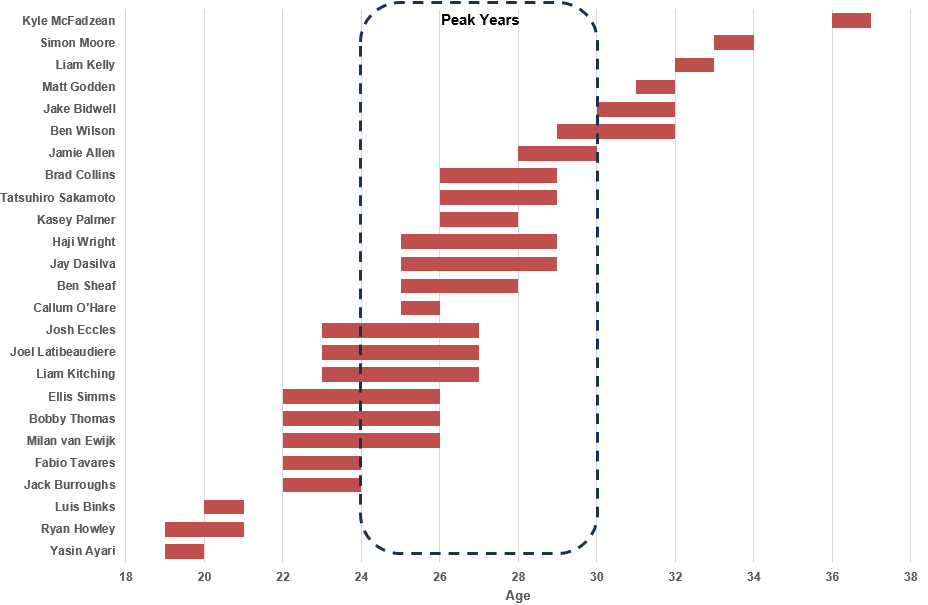
On paper, it looks a smart use of what is likely to be a one-off cash injection. However, it is making a success of this plan is what will define this football club for at least the next three or four years, and probably much longer than that.
For Mark Robins, he is now under a different kind of pressure to what he has been used to at Coventry City. Having had to make do with the players he could get his hands on, there has been greater means this summer to put together a team of his own choosing. That should be a positive, but it puts the manager in a position of having to justify his recruitment choices.
Mark Robins has made few mistakes in the transfer market during his time at the club but when he has, it has been relatively easy to back out and move on from them. There have been signings like Abu Ogogo, Junior Brown and Jonson Clarke-Harris didn’t quite fit into his tactics but they were quickly moved on and replaced with players who did. When players are signed at a higher cost and on longer-term contracts, it is harder to move them on and replace them. Tyler Walker is the biggest example of this, who was out of favour within 18 months of signing for the club and then had to effectively sit out the remainder of his contract while the team were left short of viable options in attack.
That this is a project that is intended to take place over multiple years eases some of the pressure on Mark Robins to get results with this new team quickly but how this team’s progress is assessed will ultimately be up to Doug King. Aside from changes to ticket pricing and the shirt sponsor, it is not yet clear what Doug King’s decision-making process as a football club owner is like.
Does he have a good sense of where this team needs to be over the next year or two to fulfil promotion aspirations? Is he willing or able to fund further investments in the transfer market once the Viktor Gyokeres and Gustavo Hamer money dries up? Does he know enough about football to separate results from performances? Would he be capable of making a call on Mark Robins’ position as manager if he felt it was necessary? Would he even put himself in the position to make that decision?
These are mostly questions that any newbie football club owner will be asked during their tenure, what adds to the pressure of the situation between Coventry City and Doug King is this once-in-a-generation cash injection that has come from the sales of Viktor Gyokeres and Gustavo Hamer. A significant portion of that money has been invested into this new model, while it looks a sensible plan, there is no guarantee it will succeed and it will then be up to the owner to pick the direction the club heads after that.
After two decades of penny-pinching and watching just about every other team in the Football League show ambition, now it’s Coventry City’s time to take their shot and accelerating the club’s future. The money doesn’t look like it’s been invested foolishly in mercenary talents as part of a vainglorious one-season tilt at the big time, but just because it’s been spent on players who should get better during their time with the Sky Blues doesn’t mean that will prove to be the case.
For all that has been spent on this team, patience will be key. Performances over the next few months will be about figuring out what works across this group of players. The hope is that even if this adaptation period takes a full season, most of this squad will be in place next year or two to build on that – supplemented by further signings – that ability to plan ahead several seasons is something that this football club simply hasn’t been able to do for much of its recent history.

 Sideways Sammy
Leave a comment